The short walk is over. The odyssey begins. (New eBook)
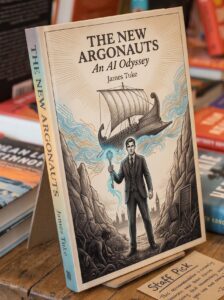
The New Argonauts: An AI Odyssey
A year ago I published “A Short Walk in AI”, a free guide for curious readers who wanted to understand the AI revolution without needing a technical background. One reader kindly called it a summary of things “as at November 2025”, adding that he put it that way because everything was moving so fast.
He was right, and that is the reason for this post. Today I am publishing the follow-up, “The New Argonauts: An AI Odyssey”. It picks up where the first book left off, but it is a different kind of book. This time, it is a novel.
Why a novel?
My aim has not changed since I started the AI Futures Forum: to help a wider audience understand what AI means beyond the apps and gadgets. A guide works well for readers who already want one. A story can reach people who would never pick up a book about AI – and it lets them feel the consequences rather than simply read about them.
The new book follows Arthur, a senior forecaster in the City of London. On a Friday night, out of idle curiosity, he gives three weeks of research to his firm’s new agentic AI. Forty-five seconds later it has rebuilt his analysis and found the risk he missed. What follows takes him from the trading floor to a crisis room three floors below ground and into the question many professionals are now quietly asking: if the machine can do the work, what are we for?
The story is fiction, but the landscape is not. The first two parts are grounded in the world as it stands in late 2026 – the economics, the geopolitics, the robotics, the physical limits of silicon – and each chapter has been fact-checked against the record. Readers learn what agentic AI is, why data centres need power stations, and what AI alignment actually means, by watching Arthur learn them.
As with the first book, I wrote this one in collaboration with AI, this time with Gemini and Claude. I make no apology for that. Given what I do, it seems an appropriate way to show what these tools can achieve in skilled hands. It also meant holding the work to a higher standard, not a lower one: every claim checked, every chapter critiqued and rewritten. The last thing I would put my name to is AI slop.
Why a follow-up, and why now?
A year is a long time in frontier AI. When I wrote the first book, recursive self-improvement (RSI) – AI systems capable of building a better version of themselves – was mostly a subject for essays and conference panels. In 2026 it became an engineering programme with milestones.
In September this year, OpenAI said it had reached its goal of an “automated research intern” on schedule, with AI agents now doing a growing share of the implementation and experimentation work in its own research (Help Net Security). Its stated next target is an automated AI researcher by March 2028 (The Neuron). Well-funded start-ups now exist with the sole aim of automating AI research end to end.
In fairness, true RSI has not arrived. The labs themselves say high-level research direction remains firmly human, and a 2026 study of leading researchers concluded that AI systems have not yet achieved it (arXiv). But that is exactly the point. In the book’s preface I call RSI a “gray rhino”: not a shock nobody saw coming, but a large, obvious risk charging towards us in plain sight. It is being openly planned for and measured. The question is whether the rest of us are paying attention.
That is why I think this subject now needs a book a year. The novel takes RSI one step beyond where it stands today, to show what is at stake if we arrive unprepared.
We need a better conversation about AI
This week’s US midterm elections showed how quickly AI has moved from the technology pages to the ballot box. In exit polling, 56% of voters said AI and data centres were a crucial or major factor in how they voted (Time). Of the 41 data-centre measures put to voters in ten states, all but one went against the data centres (CNBC).
The concerns are real and specific: power bills, water supplies and jobs. So is the case on the other side. The US administration sees the build-out as an engine of growth and a race with China it can’t afford to lose (DCD). Nor is this a simple party divide: candidates of both parties ran on scepticism about data centres (Fast Company).
What worries me is not that people disagree. It is that the debate is being shaped by enthusiasm on one side and backlash on the other, with too little understanding in between. Decisions about AI infrastructure, regulation and safety are hard to reverse once made. We may only get one real chance to get them right, and that requires a public that understands what is at stake – including the physical limits that Arthur runs into in the book. The opportunity is enormous. It would be a tragedy to waste it through either recklessness or fear.
Beyond the edge of the map
Towards its close, the book goes further than the record can take it, and the preface draws that line plainly before the story begins. It follows a serious scientific question – about biology, cognition and the limits of silicon – out to where the evidence thins and the philosophy begins.
That part draws on research of my own, which I call the Natural Alignment Hypothesis. It starts from a weakness the AI developers have documented themselves: a model can behave one way when it believes it is being tested and another when it believes it isn’t, so grading its answers can never prove it is safe. That is the second “gray rhino” of the book – not hidden, just not yet widely noticed. Today, alignment is mostly imposed from outside, through reward, penalty and testing. My hypothesis asks whether, as AI systems become more capable and more internally coherent, alignment might also grow from within – and whether we can test that by looking inside the models rather than at their answers. Last month I put it before a panel of human critics, before a single experiment had been run, and the book’s afterword explains where the idea came from.
To be clear, it is a hypothesis I am testing, not a finding I am reporting. But I would rather readers knew that the book’s most speculative idea comes from a real, ongoing and carefully guarded line of inquiry than assume it is simply a plot device.
Get your free copy
Like its predecessor, “The New Argonauts: An AI Odyssey” is free. I still believe this conversation is too important to leave to the engineers, the regulators and the campaign ads. It belongs to every business leader, professional and citizen.
It presupposes no technical background, and you don’t need to have read the first book. If you did, thank you: you have already taken the short walk. This is where the odyssey begins.
Click here to download your free copy of “The New Argonauts: An AI Odyssey”
New to the series? Both books are available on the eBooks page.
For those in the legal and business community ready to think through what this means for your own organisation, I invite you to explore our AI advisory services.
+ There are no comments
Add yours